
Investor sentiment across Asian markets has shifted sharply in August, reveals the latest Bank of America (BofA) Fund Manager Survey, which found global growth expectations retreating after three months of improvement.

Analysts have sharply reduced cigarette maker ITC's earning estimates for the next two years, fearing a significant dent in the company's profitability and margins. This is owing to a steep hike in excise duty on tobacco by the government.

'Investors should continue with their SIPs, especially during market corrections.' 'For those looking to start new SIPs, beginning with large-cap funds is a prudent strategy, followed by flexi-cap and value-oriented approaches.'

Even as concerns grow over the residential real estate market reaching its peak, the outlook for office real estate remains strong, with listed real estate investment trusts (Reits) standing to benefit from sustained demand in the segment.

The combined market valuation of eight of the top-10 most valued firms surged Rs 1,21,270.83 crore last week, with Reliance Industries becoming the biggest gainer, in line with an outstanding rally in benchmark equity indices. Last week, the BSE benchmark jumped 1,027.54 points or 1.21 per cent. The BSE Sensex hit its record high of 85,978.25 on Friday.

Among Sensex firms, Bharti Airtel, Reliance Industries, Eternal, State Bank of India, Tata Steel and HDFC Bank were the major gainers. However, Kotak Mahindra Bank, Bharat Electronics, Infosys and Bajaj Finance were among the laggards.

Investing in gold trumped most other asset classes in terms of compounded annualised returns over the long term, suggests a report by FundsIndia.

Analysts at Morgan Stanley have updated their outlook for the Indian markets, and they now expect the Sensex to hit the 107,000 mark by December 2026 in a bull-case scenario, translating into an upside of 26 per cent from current levels.

TCS emerges as biggest gainer with its m-cap advancing Rs 18,610.7 cr to Rs 4,97,168.53 cr

Asian Paints reported a good performance for the second quarter (July-September) of 2025-26 (Q2FY26), with some help from base effects, despite strong competition and extended monsoon. Volume grew in low double digits in the key domestic decorative paints, and value in that segment grew by 6 per cent. Ebitda (earnings before interest, taxes, depreciation, and amortisation) grew 21 per cent year-on-year (Y-o-Y), and PAT (profit after tax) grew 14 per cent. Asian Paints also defended market share better after several quarters where it had lost ground to Birla Opus.

Marico reported consolidated revenue growth of 20 per cent year-on-year (Y-o-Y) during the January-March quarter (Q4) of FY25. Domestic revenue surged 23 per cent Y-o-Y, while volume growth was 7 per cent. International growth stood at 11 per cent (16 per cent in constant currency growth).

Foreign investors pulled out Rs 34,993 crore (around $4 billion) from Indian equity markets in August, making it the sharpest sell-off in six months, weighed down by US tariffs on Indian exports and pricey domestic valuations. The withdrawal was nearly double the Rs 17,741 crore outflow recorded in July.

'Her outstanding performance in the World Cup has definitely added to her brand value significantly. The high WPL bids validate it more.'

'We have just scratched the surface because cricket has been around for the longest time.'

A strong performance in the July-September quarter of 2025-26 (FY26) and expectations of growth from launches and acquisition-led synergies led to a 6.65 per cent jump in the share price of Torrent Pharmaceuticals.

Stock investors will track the ongoing conflict between Iran and Israel, Brent crude oil prices, inflation data and the US Fed interest rate decision for further cues this week, analysts said. Tariff-related news would also dictate trends in the equity market, experts noted.
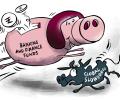
Companies in the banking, finance sector and insurance (BFSI) sector have underperformed on the bourses despite leading the earnings growth charts in the post-pandemic period. This has created a dichotomy between their earnings and share prices. BFSI companies have never been less expensive than the rest of the equity market.
Among the Sensex firms, Infosys, HCL Technologies, Bajaj Finance, Asian Paints, Tata Motors Passenger Vehicles, Tata Consultancy Services, Bharti Airtel, Titan, Bajaj Finserv, Reliance Industries and Larsen & Toubro were the gainers. Trent Ltd, Eternal, Power Grid, UltraTech Cement, Mahindra & Mahindra, Axis Bank, State Bank of India, Adani Ports, Hindustan Unilever and NTPC were the laggards.
Financial services giant HDFC Bank, carrying a brand value of $44.9 billion, has surged past IT consulting behemoth Tata Consultancy Services (TCS) to reclaim its crown as the country's most valued brand, according to the 2025 Kantar BrandZ Most Valuable Indian Brands report.

Foreign portfolio investors (FPIs) remained net sellers of Indian equities in September, withdrawing Rs 23,885 crore (around $2.7 billion) and taking year-to-date outflow to Rs 1.58 lakh crore ($17.6 billion).

'When you have the best market at your doorstep, international diversification is a distraction.'

Investors must account for currency depreciation in their financial plans and use instruments that can cushion the erosion in purchasing power.
While CIL, HDFC Bank, SBI, ICICI Bank and HDFC saw rise in their market cap, TCS, RIL, ONGC, ITC and Infosys witnessed fall in their valuations for the week ended April 25.

Cash holdings of equity mutual fund (MF) schemes moderated in September amid a slowdown in fresh inflows. Equity MF schemes held cash worth Rs 1.76 trillion at the end of September 2025 - about Rs 400 crore lower than the previous month, according to a report by Nuvama Alternative & Quantitative Research.

Largecap equities are less volatile than mid- and smallcap stocks, making them suitable for risk-averse investors.

There has been a sharp slowdown in revenue and profit growth in the cement sector in recent quarters but it is yet to show in the share prices of cement companies. On the contrary, there has been a rally in cement stocks and a re-rating of their equity valuation in the past three years despite an earnings contraction during the period.

Fund managers are divided on the prospects for beaten-down information technology (IT) stocks, reflected in the wide variance in equity mutual funds' (MFs) sector exposure. An analysis by Nuvama Alternative & Quantitative Research shows that while six large fund houses were overweight the sector relative to its weight in the Nifty 200 index, five were underweight as of October 2025. UTI MF had the highest exposure at 17.8 per cent, while SBI MF sat at the bottom with 5 per cent.

Benchmark stock indices Sensex and Nifty declined on Monday, extending the losing run to the fourth day amid selling in IT shares and foreign fund outflows. The 30-share BSE Sensex dropped by 247.01 points or 0.30 per cent to settle at 82,253.46. During the day, it fell 490.09 points or 0.59 per cent to 82,010.38 but recovered some of the losses towards the close.
From the Sensex pack, HCL Tech, Infosys, Tech Mahindra, Reliance Industries, Bajaj Finserv, ICICI Bank, Tata Motors and Eternal were the lead gainers. Power Grid, Adani Ports, IndusInd Bank, Nestle, HDFC Bank and Hindustan Unilever were among the laggards.

Building a good stock portfolio is not only about picking strong companies but also about understanding how corporate actions affect your holdings. Corporate actions such as stock splits, dividends, bonus issues, rights issues, mergers, and buybacks can change a company's valuation, share price, and your ownership.

'The reason being we cannot let premiums go beyond a certain point.'

This is the longest winning streak for gold in the last three decades.

Among Sensex firms, Tata Motors, Mahindra & Mahindra, Bharat Electronics, UltraTech Cement, Trent, Sun Pharma, Power Grid and Reliance Industries were the major laggards. However, Titan, Infosys, Tata Consultancy Services, HCL Tech and Tech Mahindra were among the biggest gainers.

Investors may wait for six months and then take another look at the stock.

It is not yet clear if Diageo Plc is looking to sell its complete stake in RCB.
Among Sensex firms, Tata Motors, Bharat Electronics, UltraTech Cement, Tech Mahindra, Mahindra & Mahindra, ICICI Bank, Tata Consultancy Services and Axis Bank were the major laggards. However, Power Grid, Hindustan Unilever, NTPC and HCL Tech were among the gainers.

'The outlook for the next Samvat is more constructive, as many of the earlier drags are gradually becoming supports.'

Biryani is set to get its own valuation. Devyani International, the largest franchisee of Kentucky Fried Chicken (KFC) quick-service restaurants (QSRs) in India, is considering the acquisition of Sky Gate Hospitality, which operates restaurants under the brand Biryani By Kilo (BBK), it said in a statement to BSE on Monday.

Currently, India has five publicly listed Reits: Brookfield India Real Estate Trust, Embassy Office Parks Reit, Mindspace Business Parks Reit Nexus Select Trust, and Knowledge Realty Trust.

Edtech unicorn PhysicsWallah on Thursday fixed a price band of Rs 103-109 per share for its upcoming initial public offering (IPO), aiming for a valuation of over Rs 31,500 crore at the upper end. The company's Rs 3,480-crore maiden public offering will open on November 11 and conclude on November 13 and anchor investors will be allocated shares on November 10, according to its public announcement.
